ThesisHub Research Resources
Research Brainstorming: From an Idea to a Research Direction
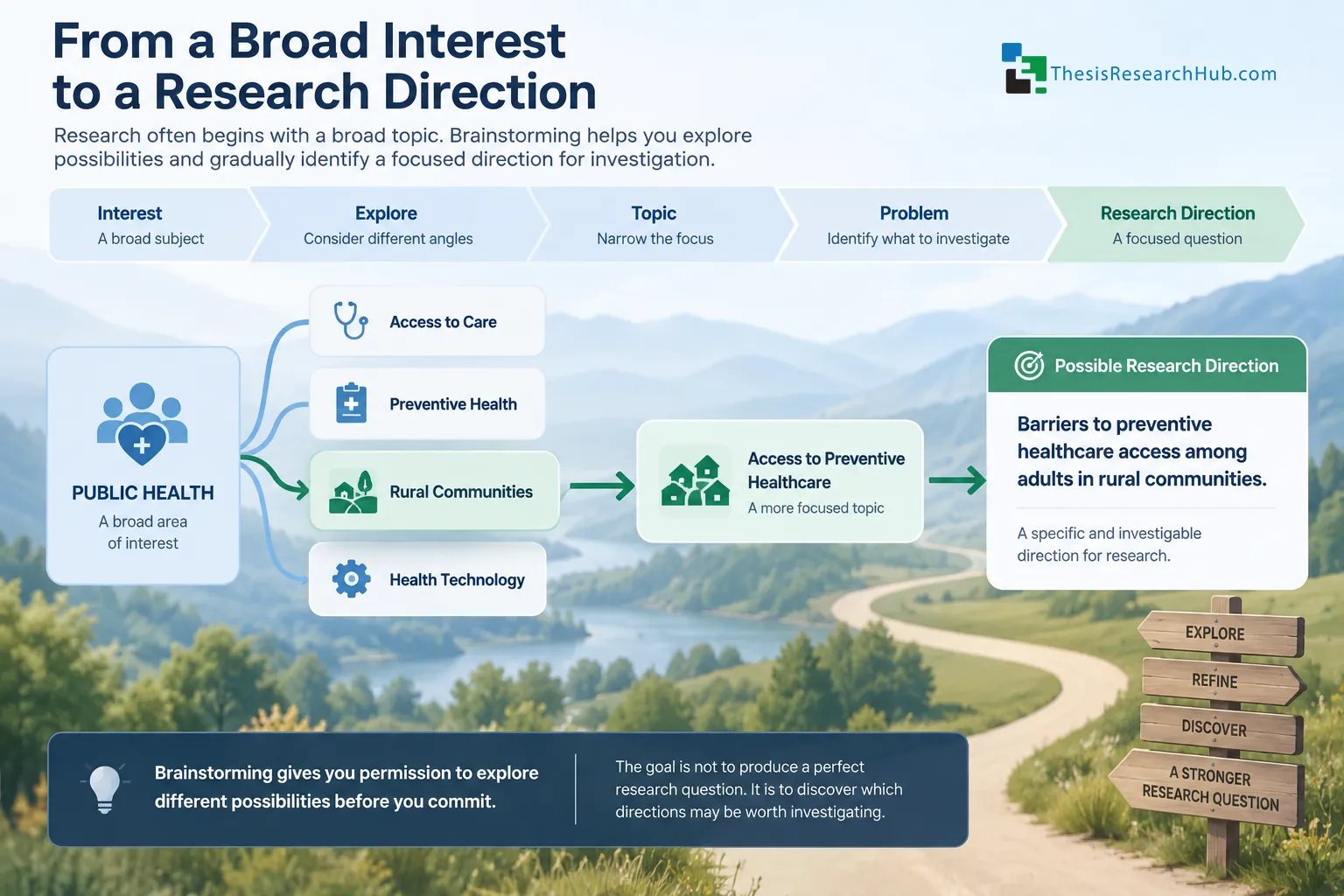
Research often begins with an interest rather than a finished research question. Brainstorming helps researchers explore that interest, identify promising problems, and gradually develop a focused direction for investigation.
Research usually begins broadly
A researcher may begin with an interest in education, technology, organizational behavior, public health, history, communication , or another broad subject.
That interest is useful, but it is usually too large to become a manageable thesis or dissertation project immediately.
Brainstorming gives you permission to explore before you commit.
The goal at this stage is not to produce a perfect research question. It is to discover which directions may be worth investigating.
Explore different dimensions of the topic
Begin by looking at your topic from several angles. Consider its populations, environments, problems, relationships, events, theories, or changes .
Questions worth asking
- → What seems surprising or unexpected?
- → What appears unresolved or poorly understood?
- → Who is most affected by the issue?
- → What has changed recently?
- → Where do researchers appear to disagree?
These observations can reveal more focused areas that deserve investigation .
Turn brainstorming into a visual mind map
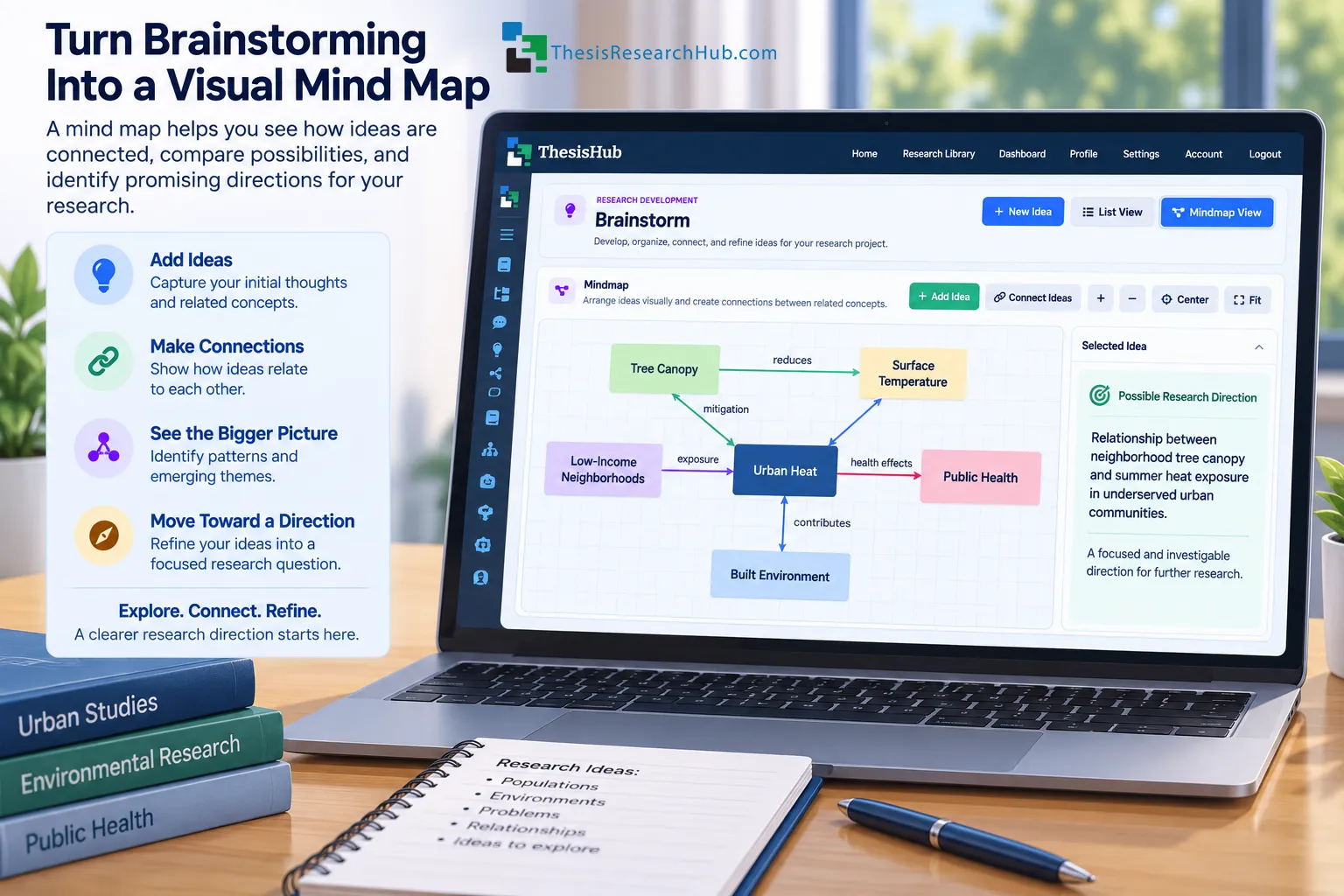
Brainstorming does not always develop in a straight line. One idea may suggest several related questions, populations, theories, problems, or possible directions.
A mind map can make those relationships easier to see by placing a central research interest in the middle and allowing related ideas to branch outward.
Brainstorm + Mind Map
Brainstorming helps generate possibilities. Mind mapping helps reveal how those possibilities may be related.
In ThesisHub, brainstorming and mind mapping can work together. Ideas developed during early exploration can be organized visually, compared, grouped, and gradually connected to a more focused research direction.
Follow the topic as it develops
A research topic rarely appears fully formed. It often develops through a series of decisions: narrowing the subject, identifying a problem, examining possible questions, discovering useful terminology, and reconsidering earlier assumptions.
Topic Assistant
Helps researchers examine an early idea through prompts, questions, keywords, and possible research directions.
Research Journey
Preserves the development of the research idea so that exploration, discoveries, and changes in direction can remain part of the larger research process.
The path to a research question can be valuable research information.
Keeping the development process visible can help explain why a topic changed and how the final direction emerged.
Capture useful ideas before they disappear
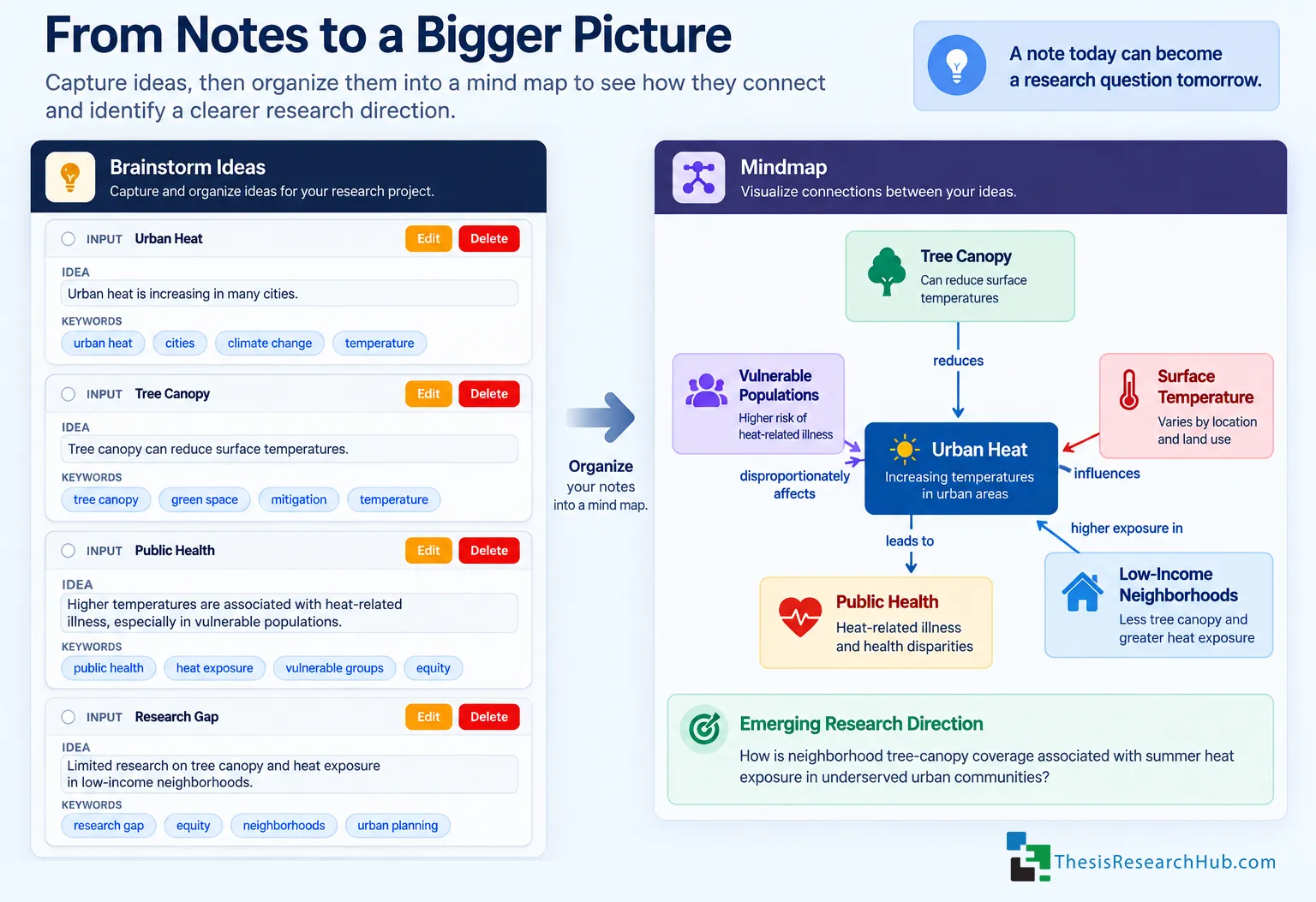
Early research often produces fragments rather than finished paragraphs: a useful observation, a possible source, a quotation to investigate, a new keyword, a question, or a connection between two ideas.
Digital notes provide a place to preserve those fragments without forcing them prematurely into the formal thesis.
A note today can become...
ThesisHub keeps research notes close to brainstorming and the developing research structure so useful ideas can move naturally from exploration into organization and eventually into writing .
Move from a topic to a problem
A strong research project generally investigates more than a subject. It addresses a problem, uncertainty, relationship, conflict, or gap in existing understanding.
Broad Topic
“I want to study remote work.”
Research Direction
How might remote work affect communication, employee performance, organizational culture, or retention within a particular population?
The second version begins to identify something that can actually be investigated .
Allow ideas to change
Early research ideas are not permanent commitments . Reading scholarly literature, examining available evidence, and considering practical limitations often causes a project to change direction.
Changing direction is not a failure.
It often means the research process is doing exactly what it should: helping you replace an initial assumption with a more informed question.
Productive brainstorming helps identify possibilities. Research then helps determine which possibilities can become meaningful and feasible studies.
The progression
You do not need to know the final research question at the beginning. The purpose of early exploration is to move progressively toward one.
Continue Your Research
Related Research Library Articles
Explore related articles for additional guidance, explanations, and research strategies.
Research Topics & Questions
Research Ethics: How to Conduct Responsible Academic Research
Research ethics helps protect participants, researchers, institutions, and the credibility of academic work. Learn the essential steps for planning and conducting responsible research.
Read Article →
Research Topics & Questions
How to Create and Plan a Research Survey
Learn how to plan a research survey by connecting your research questions to participants, variables, question design, distribution, and the evidence you need to collect.
Read Article →
How ThesisHub Helps
Support the research process without losing sight of your project
ThesisHub provides structured tools for developing research ideas, organizing early thoughts, identifying possible directions, and connecting those ideas to the later stages of a research project.
Explore More Research Topics
Thesis Writing
Develop academic writing progressively throughout a research project.
Charts & Tables
Present research findings clearly with figures, charts, and tables.
Literature Review
Organize and synthesize scholarship around a research problem.
Thesis Review
Review structure, clarity, consistency, and completeness.
Thesis Formatting
Prepare a research document for institutional and publication requirements.