ThesisHub Research Resources
Literature Review: Understanding the Research Conversation
A literature review examines the scholarship surrounding a research problem. Its purpose is not simply to summarize sources, but to explain what researchers know, where findings differ, and what questions remain.
Enter the scholarly conversation
Before contributing new research, you need to understand the work that already surrounds the problem.
That means looking for important findings, theories, methods, debates, limitations, and developments within the field.
The central question
What does the existing body of research collectively tell us about this problem?
A literature review is not a stack of summaries
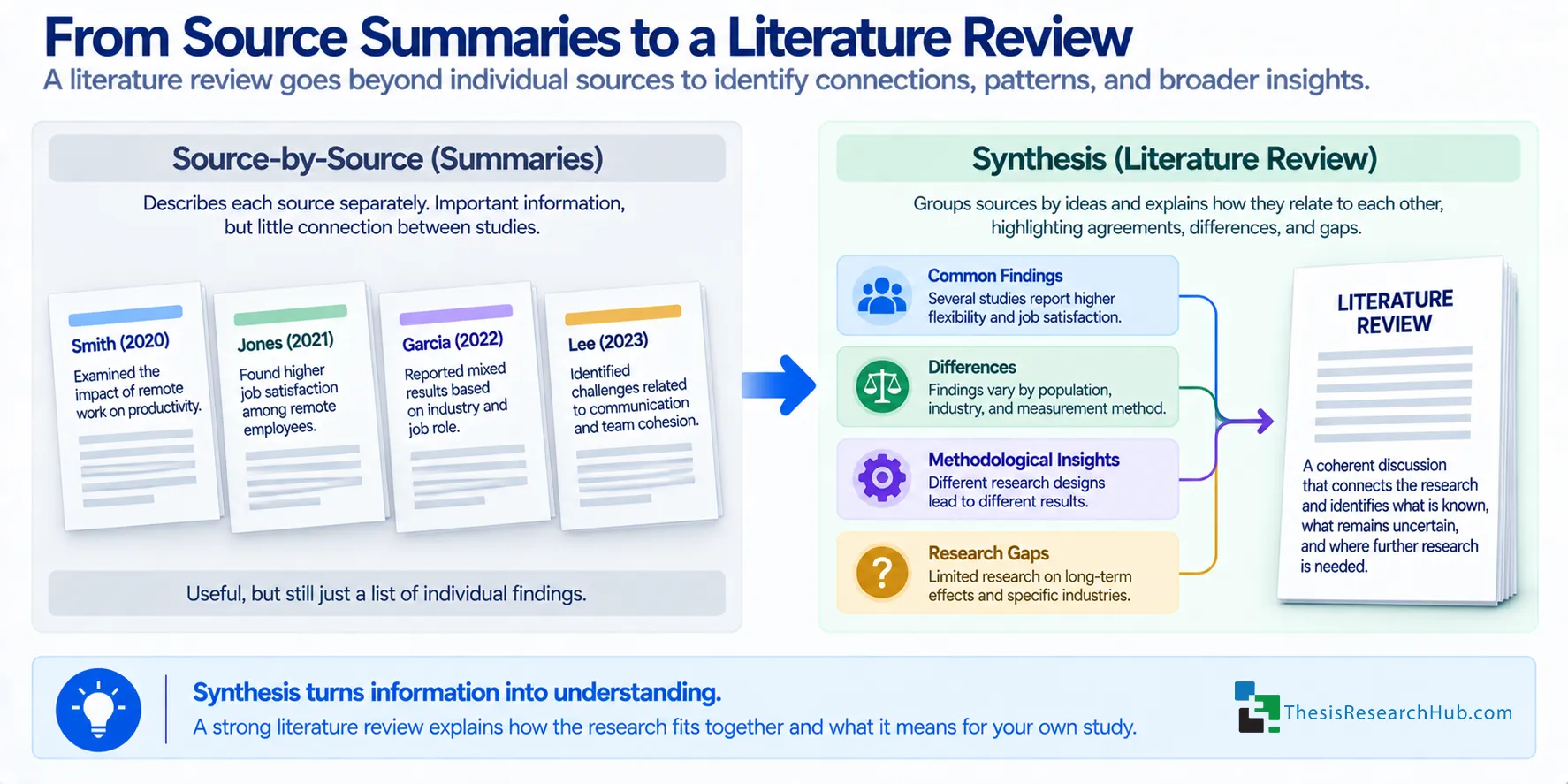
One of the most common weaknesses in literature review writing is discussing every source independently.
Source-by-source
Smith found...
Jones found...
Garcia found...
Lee found...
Synthesis
Several studies report similar outcomes, although findings differ according to the population studied and the method used to measure the result.
Synthesis allows you to explain relationships across the literature , rather than simply retelling each article.
Look for patterns across sources
Agreement
Where do several studies reach similar conclusions?
Disagreement
Where do researchers produce conflicting findings?
Methods
How do different approaches affect the results?
Populations
Which groups have received the most or least attention?
Theory
Which theoretical explanations appear repeatedly?
Limitations
What problems or constraints appear across several studies?
Use research notes to think across the literature
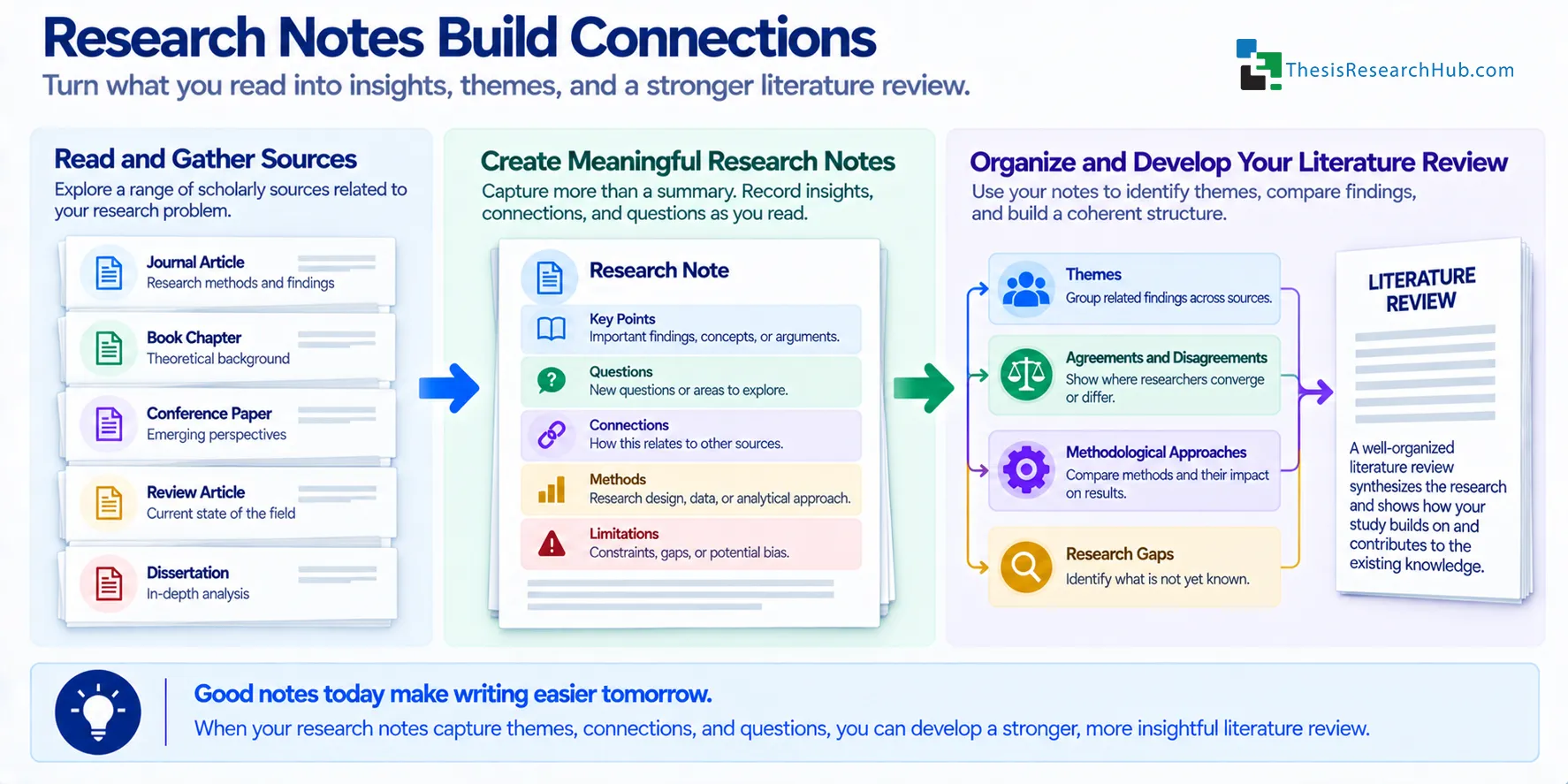
Notes are most useful when they capture more than what an individual source says.
As you read, record questions, recurring themes, disagreements, useful evidence, methodological differences, limitations, and connections to other sources .
Basic source note
“The authors found that remote employees reported higher scheduling flexibility.”
Analytical research note
“This supports the flexibility theme, but the study examined only experienced employees. Compare with studies of new employees and onboarding.”
The second note is more useful because it already begins connecting the source to the larger research conversation.
Digital notes can become the bridge between reading and writing.
In ThesisHub, notes can remain connected to the broader research project so observations gathered during reading can later contribute to brainstorming, literature review organization, outlining, and writing.
Use Research Notes to connect what you are reading
A literature review may involve dozens or even hundreds of sources. Research Notes can help preserve important observations while you read without forcing every idea immediately into the literature review itself.
Instead of recording only a summary of each source, notes can capture themes, questions, disagreements, evidence, limitations, useful quotations, methodological differences, and connections between sources .
Source Summary
What does this particular study say?
Research Note
How does this source connect to my research question, other studies, emerging themes, or something I may need to investigate further?
From reading to writing
In ThesisHub, Research Notes can remain connected to the broader research project. Ideas discovered while reviewing the literature can contribute to brainstorming, help refine the research direction, support the developing outline, and later become useful material during writing.
Notes help turn a collection of sources into a research conversation.
The goal is not simply to remember what each author wrote, but to recognize how the sources relate to one another and to the question your research is trying to answer.
Organize around ideas, not just authors
A literature review may be organized around themes, theories, methodologies, debates, populations, or historical developments .
The structure should help the reader understand the research landscape.
There is no universal set of literature review headings. The organization should emerge from the scholarship and the research problem.
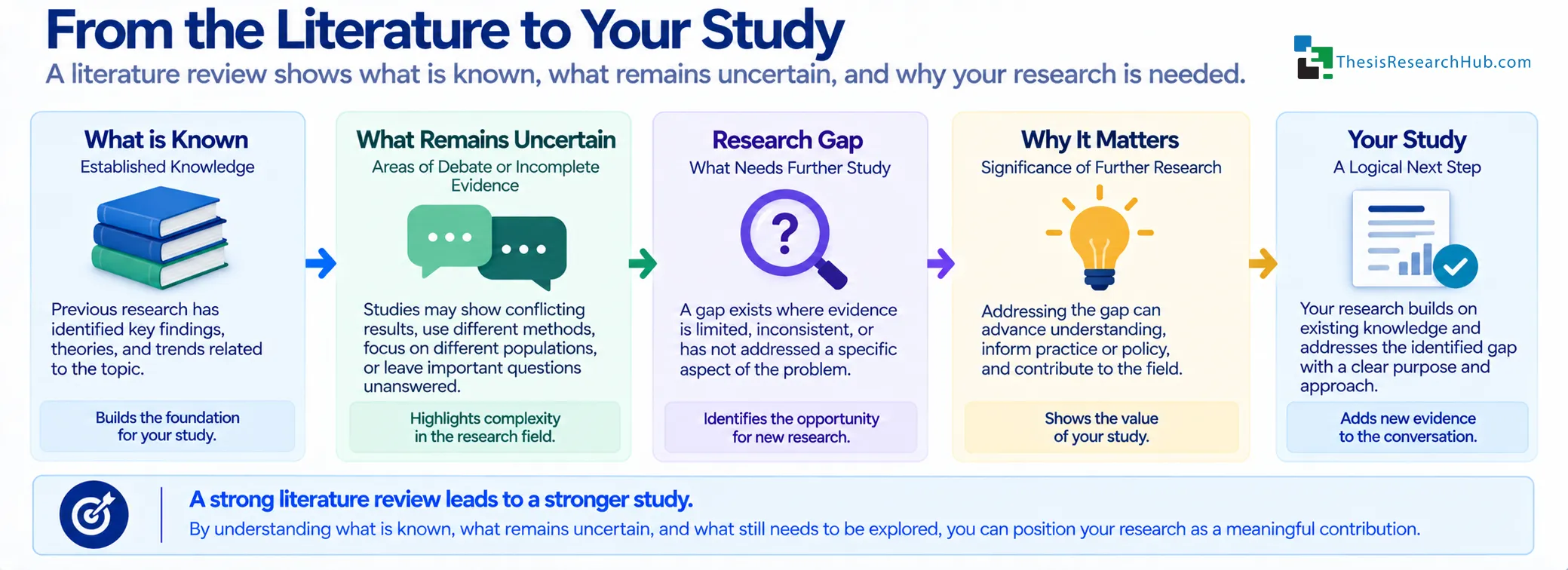
The literature should lead toward your study
By the end of the literature review, the reader should understand why your research follows logically from what has already been studied.
Continue Your Research
Related Research Library Articles
Explore related articles for additional guidance, explanations, and research strategies.
Literature & Sources
How to Identify a Research Gap
Learn how to identify meaningful gaps in existing research by examining what is known, where findings disagree, which populations or settings remain understudied, and what questions remain unanswered.
Read Article →
Literature & Sources
How to Organize Sources for a Literature Review
Learn how to organize sources for a literature review by themes, findings, relationships, and research questions so your review becomes an analysis of the literature rather than a list of summaries.
Read Article →
How ThesisHub Helps
Support the research process without losing sight of your project
ThesisHub helps researchers connect literature review development to the broader thesis structure, research notes, writing process, and emerging research questions.
Explore More Research Topics
Research Brainstorming
Develop ideas and turn broad interests into research directions.
Thesis Writing
Develop academic writing progressively throughout a research project.
Charts & Tables
Present research findings clearly with figures, charts, and tables.
Thesis Review
Review structure, clarity, consistency, and completeness.
Thesis Formatting
Prepare a research document for institutional and publication requirements.